Black Sesame Nutrition Facts: What's Actually in Every Tablespoon
By Wendy Zhang · Founder, SESAShare
By Wendy Zhang, founder of SESA
Black sesame is small, but nutritionally dense. One tablespoon (about 9g) has roughly 52 calories, 1.6g of protein, 1.1g of fiber, and over 40% of the Daily Value for copper, along with calcium, iron, magnesium and zinc. Here is the full picture, based on USDA data.
Black sesame nutrition facts
USDA doesn't publish separate data for black sesame. Because black sesame is usually eaten whole, the closest match is USDA's entry for whole, dried sesame seeds:
| Nutrient | Per tablespoon (9g) | % Daily Value | Per 100g |
|---|---|---|---|
| Calories | 52 | — | 573 |
| Protein | 1.6 g | — | 17.7 g |
| Total fat | 4.5 g | — | 49.7 g |
| Fiber | 1.1 g | 4% | 11.8 g |
| Copper | 0.37 mg | 41% | 4.08 mg |
| Manganese | 0.22 mg | 10% | 2.46 mg |
| Magnesium | 32 mg | 8% | 351 mg |
| Iron | 1.3 mg | 7% | 14.6 mg |
| Calcium | 88 mg | 7% | 975 mg |
| Zinc | 0.7 mg | 6% | 7.75 mg |
Nutrient levels in seeds vary with variety, growing conditions and processing.
What stands out
Copper is the headline. A single tablespoon covers about 40% of the Daily Value. Copper is less talked about than iron or magnesium, but it supports normal iron metabolism and connective tissue formation.
A broad mineral spread. Few everyday foods provide calcium, iron, magnesium, zinc, copper and manganese all in one place. Plant minerals are generally absorbed less efficiently than the label numbers suggest, which is why pairing matters. More on that in Is Black Sesame High in Iron?
Mostly unsaturated fat. Of the roughly 50g of fat per 100g, about 19g is monounsaturated and 22g is polyunsaturated.
Natural lignans. Sesame naturally contains lignans such as sesamin and sesamolin, plant compounds that researchers continue to study.
Black sesame vs. white sesame
The biggest nutritional difference usually comes down to whether the seed is hulled. Per 100g, USDA lists whole sesame seeds at 975mg of calcium and 14.6mg of iron, compared with 60mg of calcium and 6.4mg of iron for hulled kernels. Black sesame is typically eaten whole; white sesame is often hulled.
Is black sesame healthy?
Black sesame is a nutrient-dense whole food: a small amount delivers a meaningful range of minerals, along with protein, fiber and unsaturated fats. It is also calorie-dense, at about 573 calories per 100g, so portion size matters. In traditional diets, a tablespoon or two a day is a common amount.
How SESA uses black sesame
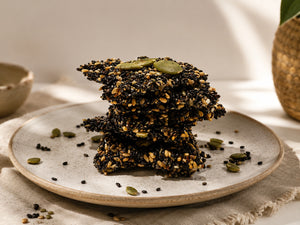
Black sesame is the main ingredient in SESA Black Sesame Crunch, combined with pumpkin, white sesame, chia and flax seeds and lightly sweetened with raw honey. One 30g serving provides 5g protein, 4g fiber, 3g sugar, and six essential minerals, including 80% DV copper and 20% DV iron. Nothing is fortified.
FAQ
What is black sesame?
Black sesame is the black-hulled variety of the sesame seed (Sesamum indicum), widely used across Asia in pastes, porridges and desserts. It has a deeper, more roasted flavor than white sesame.
How many calories are in a tablespoon of black sesame?
About 52 calories per tablespoon (9g), based on USDA data for whole sesame seeds.
What mineral is black sesame highest in?
Relative to daily needs, copper: one tablespoon provides about 41% of the Daily Value.
Source: USDA FoodData Central, Seeds, sesame seeds, whole, dried (FDC 170150); Seeds, sesame seed kernels, dried. %DV based on FDA Daily Values.